Acoustic.sa acoustic solutions, acoustic panels, soundproofing, noise control, acoustic insulation saudi arabia
The Science of Silence: Optimizing Acoustics & Reducing Echo in Riyadh Offices
Understand the physics of echo (RT60) and sound absorption (NRC). A technical guide to acoustic solutions and costs in Riyadh, from panels to Silent Space pods.
The Science of Silence: Optimizing Acoustics in Riyadh
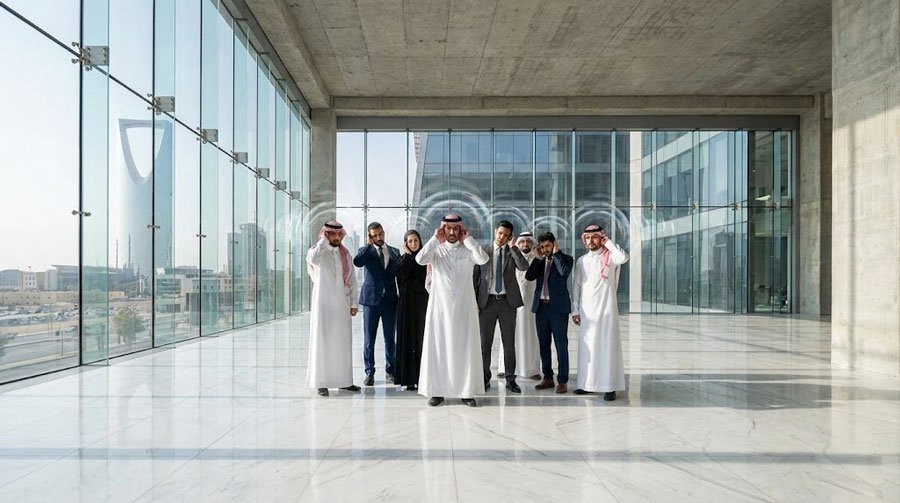
In the architectural landscape of Saudi Arabia, we prioritize light, space, and durability. This often translates to floor-to-ceiling glass, polished marble, and exposed concrete. While visually striking, these materials are acoustically “hard.” They do not absorb sound; they reflect it.
For business owners and facility managers in Riyadh, the result is often a workspace that looks professional but sounds chaotic. To solve this, we must look beyond aesthetics and understand the physics of sound.
At Acoustic.sa, we apply engineering principles to restore clarity to your environment.
The Physics of the "Riyadh Echo"
Why does a modern office in KAFD sound like a busy cafeteria? It comes down to Reverberation Time (RT60).
What is RT60? RT60 is the time it takes for a sound to decay by 60 decibels after the source stops.
Ideal Office RT60: 0.5 to 0.8 seconds.
Typical “Hard” Room: 1.5 to 3.0 seconds.
When sound waves hit a hard surface (like a glass partition), they bounce back into the room with almost zero energy loss. In a room with a high RT60, the “tail” of the first word you speak is still bouncing around when you speak the second word. These overlapping waves create “Muddy” Speech, forcing the brain to work harder to filter information—a phenomenon known as cognitive load fatigue.
Absorption vs. Isolation: The Engineering Difference
It is critical to distinguish between these two acoustic mechanisms, as they solve different problems.
1. Sound Absorption (Energy Conversion)
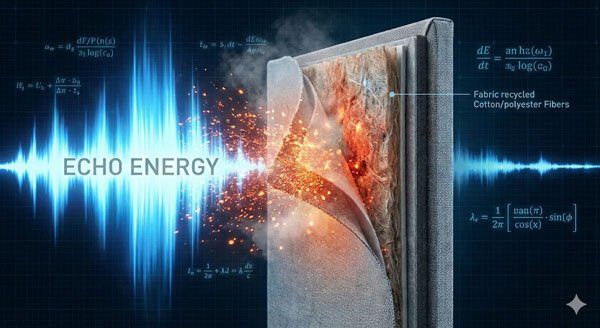
The Mechanism: When sound waves hit a porous material (like an acoustic panel), the air molecules are forced to vibrate inside the pores of the material. Friction occurs between the moving air molecules and the fibers, converting the acoustic energy into kinetic heat energy.
The Goal: Reduce reflections inside the room to lower RT60.
The Metric: NRC (Noise Reduction Coefficient).
0.0: Perfectly reflective (e.g., concrete).
0.95: Absorbs 95% of sound (e.g., high-quality fiberglass panel).
2. Sound Isolation (Transmission Loss)
The Mechanism: Preventing sound from passing through a barrier. This requires mass and decoupling.
The Goal: Privacy. Keeping sound in or out.
The Solution: Silent Space® Acoustic Pods. These units are decoupled from the building structure and use high-mass materials to block transmission.
Scientific Note: Sticking acoustic foam on a wall will not stop sound from leaking into the next room. It will only stop the echo inside the room. For privacy, you need isolation (mass); for clarity, you need absorption (porosity).
Engineered Solutions for Saudi Workspaces
1. Porous Absorbers (Wall Panels)
These are calibrated to absorb specific frequency ranges, typically the “speech bank” (500Hz – 4000Hz)
Application: Placing panels on two adjacent walls (rather than parallel walls) prevents “standing waves”—a phenomenon where low-frequency bass builds up in room corners.
Performance: Look for panels with an NRC of 0.85 or higher for meeting rooms.
2. Suspended Baffles (Diffusers & Absorbers)
In open-ceiling environments, sound travels upward and reflects off the concrete slab. Hanging baffles interrupt this path.
Dual Function: Cylindrical or blade-shaped baffles can also act as diffusers, scattering sound waves to make the room sound larger and more natural, rather than “dead.”
Cost Analysis: Investing in Acoustics in KSA
Acoustic treatment is an investment in productivity. Below is a market analysis for 2024/2025 material and installation costs in Saudi Arabia.
| Solution Grade | Tech Specs | Est. Cost (SAR/sqm) | Best Use Case |
| Grade A (Basic) | NRC 0.4 – 0.6 Compressed Polyester (PET) Felt | 150 – 250 SAR | General noise dampening in large open areas. Durable and impact-resistant. |
| Grade B (Pro) | NRC 0.8 – 0.95 Fabric-wrapped Fiberglass/Rockwool | 250- 325 SAR | Boardrooms & Private Offices. High absorption efficiency per square meter. |
| Grade C (Architectural) | NRC 0.7 – 0.9 Wood Slats with Acoustic Backing | 500- 700+ SAR | Executive Suites & Reception Areas. Combines aesthetic warmth with acoustic function. |
FAQ: Technical Acoustic Questions
A: It is the equation engineers use to calculate how much acoustic material a room needs.
(Where T is reverberation time, V is room volume, and A is total absorption).
At Acoustic.sa, we use this calculation to ensure you don’t overspend. We determine the exact square footage required to hit the target RT60.
A: Glass has an NRC of roughly 0.03, meaning it reflects 97% of human speech. To fix this without blocking the view, we recommend installing ceiling baffles or placing a Silent Space® Pod inside the glass room for sensitive calls.
Only slightly. Standard commercial carpet has a low NRC (around 0.2) and mostly absorbs high frequencies (footsteps), not human speech. It is not a replacement for wall or ceiling treatment.
Acoustic.sa acoustic solutions, acoustic panels, soundproofing, noise control, acoustic insulation saudi arabia is proudly powered by WordPress